Search For Hacking

Translate into Hacking language

Thursday, December 13, 2012

How to make key generator


                                                                          Tools!
For tools you need a minimum of debugger like SoftIce for Windows (hence WinIce), and a C compiler with Dos libraries.


Content!
In this tutorial I will show how to make a key-gen for Ize and Swiftsearch. The protection that these programs use is the well known Enter-Name-and-Registration-Number method. After selecting 'register', a window pops up where you can enter your name and your registration number. The strategy here is to find out where in memory the data you enter is stored and then to find out what is done with it. Before you go on make sure you configure the SoftIce dat file according to the PWD tutorial #1.

Part 1: Scanline Swiftsearch 2.0!

Swiftsearch is a useful little program that you can use to search on the web. I will explain step by step how to crack it.

step 1. Start the program :)

step 2: Choose register from the menus. You will now get a window where you can enter your name and your registration number.

step 3: Enter SoftIce (ctrl-d)

step 4: We will now set a breakpoint on functions like GetWindowText(a) and GetDlgItemText(a) to find out where in memory the data that we just entered is stored. The function that is used by this program is GetDlgItemTexta (trial and error, just try yourself :) so, in SoftIce type BPX GetDlgItemTexta and exit SoftIce with the g command.

step 5: Now type a name and a registration number (I used razzia and 12345) and press OK, this will put you back in SoftIce. Since you are now inside the GetDlgItemTexta function press F11 to get out of it. You should see the following code:
lea eax, [ebp-2C] :<--- we are looking for this location
push eax
push 00000404
push [ebp+08]
call [USER32!GetDlgItemTextA]
mov edi, eax :<--- eax has the length of the string
and is stored in edi for later usage.


We see that EAX is loaded with a memory address and then pushed to the stack as a parameter for the function GetDlgItemTextA. Since the function GetDlgItemTextA is already been run we can look at EBP-2c (with ED EDP-2c) and see that the name we entered is there. Now we know where the name is stored in memory, normally it would be wise to write that address down, but we will see that in this case it wont be necessary.
So, what next? Now we have to allow the program to read the registration number we entered. Just type g and return and when back in SoftIce press F11. You should see the following code:

push 0000000B
lea ecx, [ebp-18] : <--So, ebp-18 is where the reg. number
push ecx : is stored.
push 0000042A
push [ebp+08]
call [USER32!GetDlgItemTextA]
mov ebx, eax : <--save the lenght of string in EBX
test edi, edi : <--remember EDI had the lenght of the
jne 00402FBF : name we entered?
We see that the registration number is stored at location EBP-18 , check it with ED EBP-18. Again, normally it would be wise to note that address down. Also we see that it is checked if the length of the name we gave was not zero. If it is not zero the program will continue.

Step 6: Ok, now we know where the data we entered is stored in memory. What next?
Now we have to find out what is DONE with it. Usually it would we wise to put breakpoints on those memory locations and find out where in the program they are read. But in this case the answer is just a few F10's away. Press F10 until you see the following code :
cmp ebx, 0000000A :<--remember EPX had the length of the
je 00402FDE : registration code we entered?
These two lines are important. They check if the length of the registration code we entered is equal to 10. If not the registration number will be considered wrong already. The program wont even bother to check it. Modify EBX or the FLAG register in the register window to allow the jump. Continue Pressing F10 until you get to the following code (note that the adresses you will see could be different) :
:00402FDE xor esi, esi :<-- Clear ESI
:00402FE0 xor eax, eax :<-- Clear EAX
:00402FE2 test edi, edi
:00402FE4 jle 00402FF2
:00402FE6 movsx byte ptr ecx, [ebp + eax - 2C] :<-- ECX is loaded with a letter of the name we entered.
:00402FEB add esi, ecx :<-- Add the letter to ESI
:00402FED inc eax :<-- Increment EAX to get next letter
:00402FEE cmp eax, edi :<-- Did we reach the end of the string?
:00402FF0 jl 00402FE6 :<-- If not, go get the next letter.
Well, we see that the program adds together all the letters of the name we entered. Knowing that ESI contains the sum of the letters, lets continue and find out what the program does with that value :
:00402FF2 push 0000000A
:00402FF4 lea eax, [ebp-18] :<-- Load EAX with the address of the reg. number we entered
:00402FF7 push 00000000
:00402FF9 push eax :<-- Push EAX (as a parameter for the following function)
:00402FFA call 00403870 :<-- Well, what do you think this function does? :)
:00402FFF add esp, 0000000C
:00403002 cmp eax, esi :<-- Hey!
:00403004 je 00403020
We see that a function is called and when RETurned ESI is compared with EAX. Hmm, lets look at what's in EAX. A '? EAX' reveals :
00003039 0000012345 "09"
Bingo. That's what we entered as the registration number. It should have been what's inside
ESI. And we know what's inside ESI, the sum of the letters of the name we entered!


Step 7: Now we know how the program computes the registration code we can make a key-gen.
But we should not forget that the program checks also that the registration number has 10
digits.
A simple C code that will compute the registration number for this program could look like this:
#include <stdio.h>
#include <string.h>
main()
{
char Name[100];
int NameLength,Offset;
long int Reg = 0, Dummy2 = 10;
int Dummy = 0;
int LengtDummy = 1;
int Lengt , Teller;
printf("Scanline SwiftSearch 2.0 crack by raZZia.\n");
printf("Enter your name: ");
gets(Name);
NameLength=strlen(Name);
/* the for lus calculates the sum of the letters in Name */
/* and places that value in Reg */
for (Offset=0;Offset<NameLength;Offset=Offset+1)
{
Reg=Reg+Name[Offset];
}
/* the while lus calculates the lenght of the figure in */
/* Reg and places it in Lengt */
while (Dummy != 1)
{
if ( Reg < Dummy2 )
{ Lengt = LengtDummy ; Dummy =1;
}
else
{ LengtDummy=LengtDummy + 1; Dummy2=Dummy2*10;
}
};
printf("\nYour registration number is : " );
/* First print 10-Lengt times a 0 */
Lengt=10-Lengt;
for (Teller=1;Teller<=Lengt;Teller=Teller+1) printf("0");
/* Then print the registration number */
printf("%lu\n",Reg);
}


Case 2 Ize 2.04 from Gadgetware

Ize from Gadgetware is a cute little program that will put a pair of eyes on your screen which will
follow your mousepointer. It has a register function where you can enter your name and a registration
number. The strategy in this case is still the same : Find out where in memory the entered information
is stored and then find out what is done with that information.

Step 1: Start Ize. Chose register and enter a name and a number. I used 'razzia' and '12345'.

Sterp 2: Enter (CTRL-D) Softice and set a breakpoint on GetDlgItemTextA.

Step 3: Leave SoftIce and press OK. This will put you back in Softice. You will be inside the GetDlgItemTextA
function. To get out of it press F11. You should see the following code :

mov esi, [esp + 0C]
push 00000064
push 0040C3A0 :<--On this memory location the NAME we entered will be stored.
mov edi, [USER32!GetDlgItemTextA] :<--Load edi with adress of GetDlgItemTextA
push 00004EE9
push esi
call edi :<-- Call GetDlgItemTextA
push 00000064 :<-- (you should be here now)
push 0040C210 :<--On this memory location the NUMBER we entered will be stored
push 00004EEA
push esi
call edi :<-- Call GetDlgItemTextA

We see that the function GetDlgItemTextA is called twice in this code fragment. The first call has
already happened. With ED 40C3A0 we can check that the name we entered is stored on that location.
To allow the program to read in the number we entered we type G and enter. Now we are inside the Get-
DlgItemTextA function again and we press f11 to get out of it. We check memory location 40C210 and
we see the number we entered is stored there.
Now we know the locations were the name and the number are stored,we note those down!


Step 4: Ok, what next? We now know where in memory the name and the number are stored. We need to find out
what the program does with those values. In order to do that we could set breakpoints on those memory
locations to see where they are read. But in this case it wont be necessary. The answer is right after the
above code :
push 0040C210 :<--save the location of the number we entered (as a parameter for the next call)
call 00404490 :<-- call this unknown function
add esp, 00000004
mov edi, eax :<-- save EAX (hmmmm)

We see a function being called with the number-location as a parameter. We could trace into the function and see what it does, but that is not needed. With your experience of the Swiftsearch
example you should be able to guess what this function does. It calculates the numerical value of the registration number and puts it in EAX. To be sure we step further using F10 untill we are past the call and check the contents of EAX (with ? EAX). In my case it showed : 00003039 0000012345 "09".

Knowing that EDI contains our registration number we proceed:
push 0040C3A0 :<-- save the location of the name we entered (as a parameter for the next call)
push 00409080 :<-- save an unknown memory-location (as a parameter for the next call)
call 004043B0 :<--call to an unknown function
add esp, 00000008
cmp edi, eax :<--compare EDI (reg # we entered) with EAX (unknown, since the previous call changed it)
jne 004018A1 :<--jump if not equal

We see that a function is called with two parameters. One of the parameters is the location of the name
we entered. The other we dont know, but we can find out with ED 409080. We see the text 'Ize'.
This function calculates the right registration number using those two parameters. If you just want to
crack this program, you can place a breakpoint right after the call and check the contents of EAX. It will
contain the right registration number. But since we want to know HOW the reg. # is calculated we will trace inside the function (using T). We will then try to find out HOW the contents of EAX got in there.


Step 5: Once inside the interesting function you will see that we are dealing with a rather long function. It wont be necessary for me to include the complete listing of this function, because we wont need all of it to make our key-gen.
But in order find out which part of the code is essential for the computation of the right registration number, you have to trace STEP by STEP and figure out what EXACTLY is going on!
Afther doing this i found out that the first part of the function computes some kind of "key". Then this
"key" is stored in memory and in that way passed on to the second part of the function.
The second part of the function then computes the right registration number, based on this "key" AND
the name we entered.


The code that is essential and that we need for our key-gen is the following:
( Note that before the following code starts, the registers that are used will have the following values:
EBX will point to the first letter of the name we entered,
EDX will be zero,
EBP will be zero,
The "key" that we talked about earlier is stored in memory location 0040B828 and will
have 0xA4CC as its initial value. )
:00404425 movsx byte ptr edi, [ebx + edx] :<-- Put first letter of the name in EDI
:00404429 lea esi, [edx+01] :<-- ESI gets the "letter-number"
:0040442C call 00404470 :<-- Call function
:00404431 imul edi, eax :<-- EDI=EDI*EAX (eax is the return value of the the previous call)
:00404434 call 00404470 :<-- Call function
:00404439 mov edx, esi
:0040443B mov ecx, FFFFFFFF
:00404440 imul edi, eax :<-- EDI=EDI*EAX (eax is the return value of the previous call)
:00404443 imul edi, esi :<-- EDI=EDI*ESI ( esi is the number of the letter position)
:00404446 add ebp, edi :<-- EBP=EBP+EDI (beware that EBP will finally contain the right reg#)
:00404448 mov edi, ebx :<--these lines compute the lenght of the name we entered
:0040444A sub eax, eax :<--these lines compute the lenght of the name we entered
:0040444C repnz :<--these lines compute the lenght of the name we entered
:0040444D scasb :<--these lines compute the lenght of the name we entered
:0040444E not ecx :<--these lines compute the lenght of the name we entered
:00404450 dec ecx :<-- ECX now contains the lenght of the name
:00404451 cmp ecx, esi
:00404453 ja 00404425 :<-- If its not the end of the name , go do the same with the next letter
:00404455 mov eax, ebp :<-- SAVE EBP TO EAX !!!!
:00404457 pop ebp
:00404458 pop edi
:00404459 pop esi
:0040445A pop ebx
:0040445B ret
_____
:00404470 mov eax, [0040B828] :<-- Put "key" in EAX
:00404475 mul eax, eax, 015A4E35 :<-- EAX=EAX * 15A4E35
:0040447B inc eax :<-- EAX=EAX + 1
:0040447C mov [0040B828], eax :<-- Replace the "key" with the new value of EAX
:00404481 and eax, 7FFF0000 :<-- EAX=EAX && 7FFF0000
:00404486 shr eax, 10 :<-- EAX=EAX >>10
:00404489 ret

The above code consists of a loop that goes trough all the letters of the name we entered. With each
letter some value is calculated, all these values are added up together (in EBP). Then this value is stored
in EAX and the function RETurns. And that was what we were looking for, we wanted to know how EAX got its value!

Step 6: Now to make a key-gen we have to translate the above method of calculating the right reg# into a
c program. It could be done in the following way :
(Note : I am a bad c programmer :)
#include <stdio.h>
#include <string.h>
main()
{
char Name[100];
int NameLength,Offset;
unsigned long Letter,DummyA;
unsigned long Key = 0xa4cc;
unsigned long Number = 0;
printf("Ize 2.04 crack by razzia\n");
printf("Enter your name: ");
gets(Name);
NameLength=strlen(Name);
for (Offset=0;Offset<NameLength;Offset=Offset+1)
{
Letter=Name[Offset];
DummyA=Key;
DummyA=DummyA*0x15a4e35;
DummyA=DummyA+1;
Key=DummyA;
DummyA=DummyA & 0x7fff0000;
DummyA=DummyA >> 0x10;
Letter=Letter*DummyA;
DummyA=Key;
DummyA=DummyA*0x15a4e35;
DummyA=DummyA+1;
Key=DummyA;
DummyA=DummyA & 0x7fff0000;
DummyA=DummyA >> 0x10;
Letter=Letter*DummyA;
Letter=Letter*(Offset+1);
Number=Number+Letter;
}
printf("\nYour registration number is : %lu\n",Number);
}

you are done                                  ENJOY

Wednesday, December 12, 2012

Download Hackety hack


 Hackety Hack will teach you the absolute basics of programming from the ground up. No previous programming experience is needed!
With Hackety Hack, you'll learn the Ruby programming language. Ruby is used for all kinds of programs, including desktop applications and websites.

Learn and Explore

Hackety Hack uses the Shoes toolkit to make it really easy and fun to build graphical interfaces. Several lessons and example programs are provided, showing you how to make all kinds of fun things!
Check out what other people are doing with Hackety Hack! The Programs section is chock full of fun projects from other Hackety users. You can even upload your own! Put your account information into the Hackety Hack app, and you'll be able to share all the programs you create.

HOW TO INSTALL
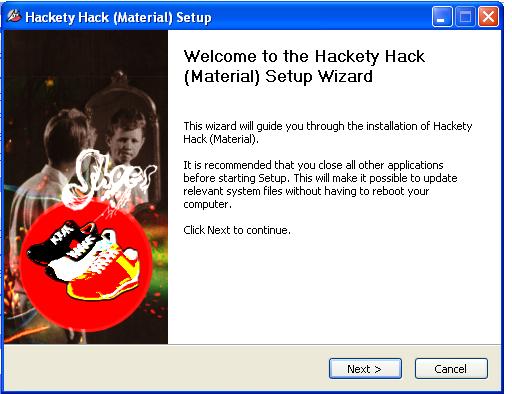
1.Download it and click on setup file


2.Follow the on screen instructions to install. as shown in the pictures below


Download it from here Hackety Hack
Learn it. and ENJOY.............


Tuesday, December 11, 2012

Sharecash Money making trick


The method inscribed here is completely black hat. If you don't follow the steps correctly you will be banned and we won't be responsible for that. You cannot share the content of this e-book because you have no resell rights for it.
In this e-book I will teach you how to download your own files from sharecash.org and get $1.5 per download. After following the instructions in here you will be able to do this as many times as you want and avoid getting banned from the site.
You cannot blame me if the survey disappears from the offers in some time. This is possible so you better do your job now. When I say now I don't mean by the time you read this but when you understand the method. On the other hand, if you will wait for 2 years to do this method it would be possible it will fail.
Something else. Using this method you will be completely untraceable because here you will learn how to change HWID, MAC and IP address (You could also use this method for carding if you have a better VPN that the one I give here because it protects you from sharecash.org but I am not sure about other sites).


persnal  methods don't leech it

Download it from here sharecash ebook

                                                           ENJOY

Camtasia Studio (Free)


As you all  know every one wants to create their own lectures videos for study or some hacking works.
Then you will on right place Camtasia Studio gives you the power to do all that.

Camtasia Studio and Camtasia for Mac are software applications for creating video tutorials and presentations (screen video capture), published by TechSmith. The exact screen area to be captured can be specified, and audio may be recorded simultaneously from any standard input source.


Camtasia Studio Features


Capture What You're Seeing and Doing

Create Videos with Professional Polish

Share and Interact with Your Audience

Camtasia Studio 8 System Requirements
Minimum Requirements:
  • Microsoft Windows XP, Windows Vista, Windows 7, or Windows 8
  • Microsoft DirectX 9 or later version
  • Microsoft .NET 4.0 Client Profile (included)
  • Dual-core processor minimum ~ Recommended: Quad-core processor or better
  • 2 GB RAM minimum ~ Recommended: 4 GB or more
  • 2 GB of hard-disk space for program installation
  • Display dimensions of 1024x768 or greater
  • Dedicated Windows-compatible sound card, microphone and speakers (recommended)
Feature-Specific Requirements:
  • Camtasia Studio Add-in for PowerPoint requires PowerPoint 2007 or 2010 (32 bit)  
  • Import of .mov and production to .mov and .m4v requires Apple QuickTime 7.2 or later
  • Camera video recording requires a USB Web Camera. Recording live from a DV camera is not supported 
  • Integration with Camtasia Relay requires Camtasia Relay Client Recorder
  • GPU acceleration requires DirectX 9 compatible video adpater with 128 MB of video memory or greater and Pixel Shader 2.0 or later

Download it from here camatasia studio


                                                                  RENJOY


Sunday, December 9, 2012

45 free online computer science courses


Missed lectures or hate teachers? Or want to study computer science courses without going to university? … You can study anytime anywhere because there are number of free online computer science courses available on internet that are very interactive.


Here is the list of 45 free online computer science courses that are designed by teaching experts from best universities of the world (almost the whole graduation!).
Complete set of course materials. (Includes all available handouts, assignments, exams, and computer software.
This course is the natural successor to Programming Methodology and covers such advanced programming topics as recursion, algorithmic analysis, and data abstraction using the C++ programming language, which is similar to both C and Java. If you've taken the Computer Science AP exam and done well (scored 4 or 5) or earned a good grade in a college course, Programming Abstractions may be an appropriate course for you to start with, but often Programming Abstractions (Accelerated) is a better choice. Programming Abstractions assumes that you already have familiarity with good programming style and software engineering issues (at the level of Programming Methodology), and that you can use this understanding as a foundation on which to tackle new topics in programming and data abstraction.
Advanced memory management features of C and C++; the differences between imperative and object-oriented paradigms. The functional paradigm (using LISP) and concurrent programming (using C and C++). Brief survey of other modern languages such as Python, Objective C, and C#.
The purpose of this course is to introduce you to basics of modeling, design, planning, and control of robot systems. In essence, the material treated in this course is a brief survey of relevant results from geometry, kinematics, statics, dynamics, and control.
The course is presented in a standard format of lectures, readings and problem sets. There will be an in-class midterm and final examination. These examinations will be open book. Lectures will be based mainly, but not exclusively, on material in the Lecture Notes book. Lectures will follow roughly the same sequence as the material presented in the book, so it can be read in anticipation of the lectures
This course is designed to introduce students to the fundamental concepts and ideas in natural language processing (NLP), and to get them up to speed with current research in the area. It develops an in-depth understanding of both the algorithms available for the processing of linguistic information and the underlying computational properties of natural languages. Wordlevel, syntactic, and semantic processing from both a linguistic and an algorithmic perspective are considered. The focus is on modern quantitative techniques in NLP: using large corpora, statistical models for acquisition, disambiguation, and parsing. Also, it examines and constructs representative systems.
You can study anytime anywhere because there are number of free online computer science courses offered by distance learning universities available on internet that are very interactive.
This course provides a broad introduction to machine learning and statistical pattern recognition.
The goals for the course are to gain a facility with using the Fourier transform, both specific techniques and general principles, and learning to recognize when, why, and how it is used. Together with a great variety, the subject also has a great coherence, and the hope is students come to appreciate both.
Introduction to applied linear algebra and linear dynamical systems, with applications to circuits, signal processing, communications, and control systems.
Concentrates on recognizing and solving convex optimization problems that arise in engineering. Convex sets, functions, and optimization problems. Basics of convex analysis. Least-squares, linear and quadratic programs, semidefinite programming, minimax, extremal volume, and other problems. Optimality conditions, duality theory, theorems of alternative, and applications. Interiorpoint methods. Applications to signal processing, control, digital and analog circuit design, computational geometry, statistics, and mechanical engineering.
Continuation of Convex Optimization I. Subgradient, cutting-plane, and ellipsoid methods. Decentralized convex optimization via primal and dual decomposition. Alternating projections. Exploiting problem structure in implementation. Convex relaxations of hard problems, and global optimization via branch & bound. Robust optimization. Selected applications in areas such as control, circuit design, signal processing, and communications. Course requirements include a substantial project.
This subject is aimed at students with little or no programming experience. It aims to provide students with an understanding of the role computation can play in solving problems. It also aims to help students, regardless of their major, to feel justifiably confident of their ability to write small programs that allow them to accomplish useful goals. The class will use the Python™ programming language.
This course provides an introduction to mathematical modeling of computational problems. It covers the common algorithms, algorithmic paradigms, and data structures used to solve these problems. The course emphasizes the relationship between algorithms and programming, and introduces basic performance measures and analysis techniques for these problems.
This course explores the ultimate limits to communication and computation, with an emphasis on the physical nature of information and information processing. Topics include: information and computation, digital signals, codes and compression, applications such as biological representations of information, logic circuits, computer architectures, and algorithmic information, noise, probability, error correction, reversible and irreversible operations, physics of computation, and quantum computation. The concept of entropy applied to channel capacity and to the second law of thermodynamics.
This course teaches simple reasoning techniques for complex phenomena: divide and conquer, dimensional analysis, extreme cases, continuity, scaling, successive approximation, balancing, cheap calculus, and symmetry. Applications are drawn from the physical and biological sciences, mathematics, and engineering. Examples include bird and machine flight, neuron biophysics, weather, prime numbers, and animal locomotion. Emphasis is on low-cost experiments to test ideas and on fostering curiosity about phenomena in the world.
This course provides a challenging introduction to some of the central ideas of theoretical computer science. It attempts to present a vision of "computer science beyond computers": that is, CS as a set of mathematical tools for understanding complex systems such as universes and minds. Beginning in antiquity—with Euclid's algorithm and other ancient examples of computational thinking—the course will progress rapidly through propositional logic, Turing machines and computability, finite automata, Gödel's theorems, efficient algorithms and reducibility, NP-completeness, the P versus NP problem, decision trees and other concrete computational models, the power of randomness, cryptography and one-way functions, computational theories of learning, interactive proofs, and quantum computing and the physical limits of computation. Class participation is essential, as the class will include discussion and debate about the implications of many of these ideas
This course is an introduction to Java™ programming and software engineering. It is designed for those who have little or no programming experience in Java and covers concepts useful to 6.005. The focus is on developing high quality, working software that solves real problems. Students will learn the fundamentals of Java, and how to use 3rd party libraries to get more done with less work. Each session includes one hour of lecture and one hour of assisted lab work. Short labs are assigned with each lecture.
This course provides an aggressively gentle introduction to MATLAB®. It is designed to give students fluency in MATLAB, including popular toolboxes. The course consists of interactive lectures with a computer running MATLAB for each student. Problem-based MATLAB assignments are given which require significant time on MATLAB.
This course is designed for undergraduate and graduate students in science, social science and engineering programs who need to learn fundamental programming skills quickly but not in great depth. The course is ideal for undergraduate research positions or summer jobs requiring C++. It is not a class for experienced programmers in C++. Students with no programming background are welcome. Topics include control structures, arrays, functions, classes, objects, file handling, and simple algorithms for common tasks.
This course teaches the art of guessing results and solving problems without doing a proof or an exact calculation. Techniques include extreme-cases reasoning, dimensional analysis, successive approximation, discretization, generalization, and pictorial analysis. Applications include mental calculation, solid geometry, musical intervals, logarithms, integration, infinite series, solitaire, and differential equations. (No epsilons or deltas are harmed by taking this course.)This course is offered during the Independent Activities Period (IAP), which is a special 4-week term at MIT that runs from the first week of January until the end of the month.
The course serves as an introductory course in parallel programming. It offers a series of lectures on parallel programming concepts as well as a group project providing hands-on experience with parallel programming. The students will have the unique opportunity to use the cutting-edge PLAYSTATION 3 development platform as they learn how to design and implement exciting applications for multicore architectures. At the end of the course, students will have an understanding of:
1) Fundamental design philosophies that multicore architectures address.
2) Parallel programming philosophies and emerging best practices.
This course will provide a gentle introduction to programming using Python™ for highly motivated students with little or no prior experience in programming computers. The course will focus on planning and organizing programs, as well as the grammar of the Python programming language. Lectures will be interactive featuring in-class exercises with lots of support from the course staff.
6.270 is a hands-on, learn-by-doing class, in which participants design and build a robot that will play in a competition at the end of January. The goal for the students is to design a machine that will be able to navigate its way around the playing surface, recognize other opponents, and manipulate game objects. Unlike the machines in Design and Manufacturing I (2.007), 6.270 robots are totally autonomous, so once a round begins, there is no human intervention.
6.837 offers an introduction to computer graphics hardware, algorithms, and software. Topics include: line generators, affine transformations, line and polygon clipping, splines, interactive techniques, perspective projection, solid modelling, hidden surface algorithms, lighting models, shading, and animation. Substantial programming experience is required. This course is worth 6 Engineering Design Points.
NextLab is a hands-on year-long design course in which students research, develop and deploy mobile technologies for the next billion mobile users in developing countries. Guided by real-world needs as observed by local partners, students work in multidisciplinary teams on term-long projects, closely collaborating with NGOs and communities at the local level, field practitioners, and experts in relevant fields.
This course focuses on the algorithmic and machine learning foundations of computational biology, combining theory with practice. We study the principles of algorithm design for biological datasets, and analyze influential problems and techniques. We use these to analyze real datasets from large-scale studies in genomics and proteomics. The topics covered include:
  • Genomes: Biological Sequence Analysis, Hidden Markov Models, Gene Finding, RNA Folding, Sequence Alignment, Genome Assembly.
  • Networks: Gene Expression Analysis, Regulatory Motifs, Graph Algorithms, Scale-free Networks, Network Motifs, Network Evolution.
  • Evolution: Comparative Genomics, Phylogenetics, Genome Duplication, Genome Rearrangements, Evolutionary Theory, Rapid Evolution.
Basic concept of computer science The C programming language
This course is offered to undergraduates and is an elementary discrete mathematics course oriented towards applications in computer science and engineering. Topics covered include: formal logic notation, induction, sets and relations, permutations and combinations, counting principles, and discrete probability.
This unit will introduce you to some ideas about how information and communiction technologies (ICTs) systems work. We will look at how ICT systems convey, store and manipulate data, and how they process…
From Issac Asimov's I Robot to George Lucas' R2D2, robots have been part of our popular culture for the last century. In this introductory programming course, we use Lego Mindstorm robots to illustrate the fundamental concepts in computer programming and problem solving. Students get a chance to explore Robotics and Computing Science in a fun and stimulating way.
Course for students in Computer Information Systems or in Computer and Information Technologies programs. This course will instruct students in system administration topics, including computer hardware selection, user account management, file system optimization, and security. Basic system services such as FTP, WWW, email, printer, and DBMS will also be covered. Students will be required to install, configure, and test the services in a server environment. Three lecture hours per week.
In this OpenUW course, we cover the basic structure of an HTML document, what HTML tags look like, the fundamental document structure, and basic tags found in nearly all HTML documents.
In this course you will learn how to use application software. This course will help you learn how to use Internet, word processing software, spreadsheet software, presentation software and communications applications. You will also learn how to integrate MS Office 2007 applications, including linking and embedding files. Editing and formatting these documents helps a business to create more professional looking documents.
This course extends the student's basic procedural design and programming knowledge into the object oriented paradigm. The student will be expected to learn and apply the basic concepts of object oriented design and programming, i.e. abstraction, inheritance and polymorphism, in the context of the C++ language. Key software engineering principles such as decomposition and component re-use shall also be emphasized.
Detailed concepts of Operating Systems and System Programming
The core concepts of data structuring with inspiring lectures
An introduction to the main techniques of Artifical Intelligence: state-space search methods, semantic networks, theorem-proving and production rule systems. Important applications of these techniques are presented. Students are expected to write programs exemplifying some of techniques taught, using the LISP lanuage.
Information theory explores the fundamental limits of the representation and transmission of information. We will focus on the definition and implications of (information) entropy, the source coding theorem, and the channel coding theorem. These concepts provide a vital background for researchers in the areas of data compression, signal processing, controls, and pattern recognition.
Communication networks are used to transfer valuable and confidential information for a variety of purposes. As a consequence, they attract the attention of people who intend to steal or misuse information,...
Discrete mathematics, also called finite mathematics or decision mathematics, is the study of mathematical structures that are fundamentally discrete in the sense of not supporting or requiring the notion of continuity. Objects studied in finite mathematics are largely countable sets such as integers, finite graphs, and formal languages. Concepts and notations from discrete mathematics are useful to study or describe objects or problems in computer algorithms and programming languages.
Deep analysis of computer language syntax and structures
Fundamental dynamic data structures, including linear lists, queues, trees, and other linked structures; arrays strings, and hash tables. Storage management. Elementary principles of software engineering. Abstract data types. Algorithms for sorting and searching. Introduction to the Java programming language.
This course is offered to undergraduates and introduces basic mathematical models of computation and the finite representation of infinite objects. The course is slower paced than 6.840J/18.404J. Topics covered include: finite automata and regular languages, context-free languages, Turing machines, partial recursive functions, Church's Thesis, undesirability, reducibility and completeness, time complexity and NP-completeness, probabilistic computation, and interactive proof systems.
Basic concepts of operating systems and system programming. Utility programs, subsystems, multiple-program systems. Processes, interposes communication, and synchronization. Memory allocation, segmentation, paging. Loading and linking, libraries. Resource allocation, scheduling, performance evaluation. File systems, storage devices, I/O systems. Protection, security, and privacy.
This course examines how randomization can be used to make algorithms simpler and more efficient via random sampling, random selection of witnesses, symmetry breaking, and Markov chains. Topics covered include: randomized computation; data structures (hash tables, skip lists); graph algorithms (minimum spanning trees, shortest paths, minimum cuts); geometric algorithms (convex hulls, linear programming in fixed or arbitrary dimension); approximate counting; parallel algorithms; online algorithms; derandomization techniques; and tools for probabilistic analysis of algorithms.
university of phoenix arizona is one of the best choices in studying information technology online.
All course descriptions are re-quoted from the mentioned links.
<a href="http://phoenix.19gi.com/state/Arizona/">university of phoenix arizona</a> is one of the best choices in studying information technology online.
If you wan to get a+ certification then try out our microsoft dumps to get quick success in real exam.